Does Red Wine Really Help Your Heart? (The Science, No Hype)




April 2, 2026

Hey, let's talk about the headline we've all seen (and maybe secretly hoped was true): "Red Wine Is Good for Your Heart."
It's comforting, right? You pour a glass of Pinot after a long day, and instead of guilt, you get… health benefits? It feels like the universe is giving you a high-five.
But here's the thing: science is messy. Headlines are simple. And the truth about red wine and heart health lives somewhere in the middle, not in a "miracle cure" camp, but not in a "it's poison" camp either.

So let's cut through the noise. No fear-mongering, no wine-industry propaganda, just the actual science explained like we're chatting over coffee (or, you know, a glass of something red). We'll talk about resveratrol, the "French Paradox," what "moderate" actually means, and whether you should start drinking for your heart or just drink because you love it.
Back in the early '90s, scientists noticed something weird. The French ate a diet high in saturated fat (cheese, butter, croissants: oh my), smoked more than Americans, and exercised less. Yet, they had way lower rates of heart disease.
This was called the French Paradox. And researchers started wondering: what were the French doing that we weren't?
One big difference? They drank red wine. Regularly. With meals. In moderation.
So the theory was born: maybe red wine is the secret shield. Maybe it's not despite the fat and wine that the French had healthy hearts, maybe it was because of the wine.
Fast-forward 30 years, and we've learned a lot. Some of that early excitement was overhyped. Some of it holds up. Let's break it down.
If you've heard one thing about red wine and health, it's probably about resveratrol. It's a polyphenol (a plant compound) found in grape skins, especially in red grapes. It's an antioxidant, and in lab studies, it does some pretty amazing things:
Sounds like a superhero, right? So here's the catch: most of those studies were done in a petri dish or on animals, using doses way higher than you'd ever get from wine.
To get the amount of resveratrol used in those mouse studies, you'd need to drink something like 100 to 1,000 glasses of red wine a day. Which, obviously, would kill you long before it made you immortal.
The reality check: A typical glass of red wine has about 0.2 to 2 milligrams of resveratrol. The doses used in promising human trials are often 500 to 1,000 milligrams. You'd need a supplement, not a Cabernet.
So is resveratrol useless? No. It's probably part of the story. But it's not the whole story. And it's definitely not a reason to start chugging bottles.
If you want resveratrol without the alcohol, eat red grapes, blueberries, or peanuts. Or take a supplement (talk to your doctor first). But don't drink three glasses thinking you're dosing yourself with antioxidants. You're just drinking three glasses.
Okay, so resveratrol alone isn't the magic bullet. But what about red wine as a whole? Do people who drink it actually have healthier hearts?
The short answer: Yes, but with a huge asterisk.
Hundreds of observational studies have found a J-shaped curve when it comes to alcohol and heart health:
Moderate drinkers tend to have:
One major study published in The Lancet followed over 100,000 people and found that light to moderate drinkers had a 20-30% lower risk of heart attack compared to non-drinkers.
But here's the asterisk: These are observational studies. They show correlation, not causation. And there's a big confounding factor: lifestyle.
People who drink wine in moderation tend to:
So is it the wine? Or is it the whole package; the slower pace, the social bonding, the better food?
Most experts now think it's both. The alcohol itself does raise HDL and reduce clotting. But the context matters just as much.
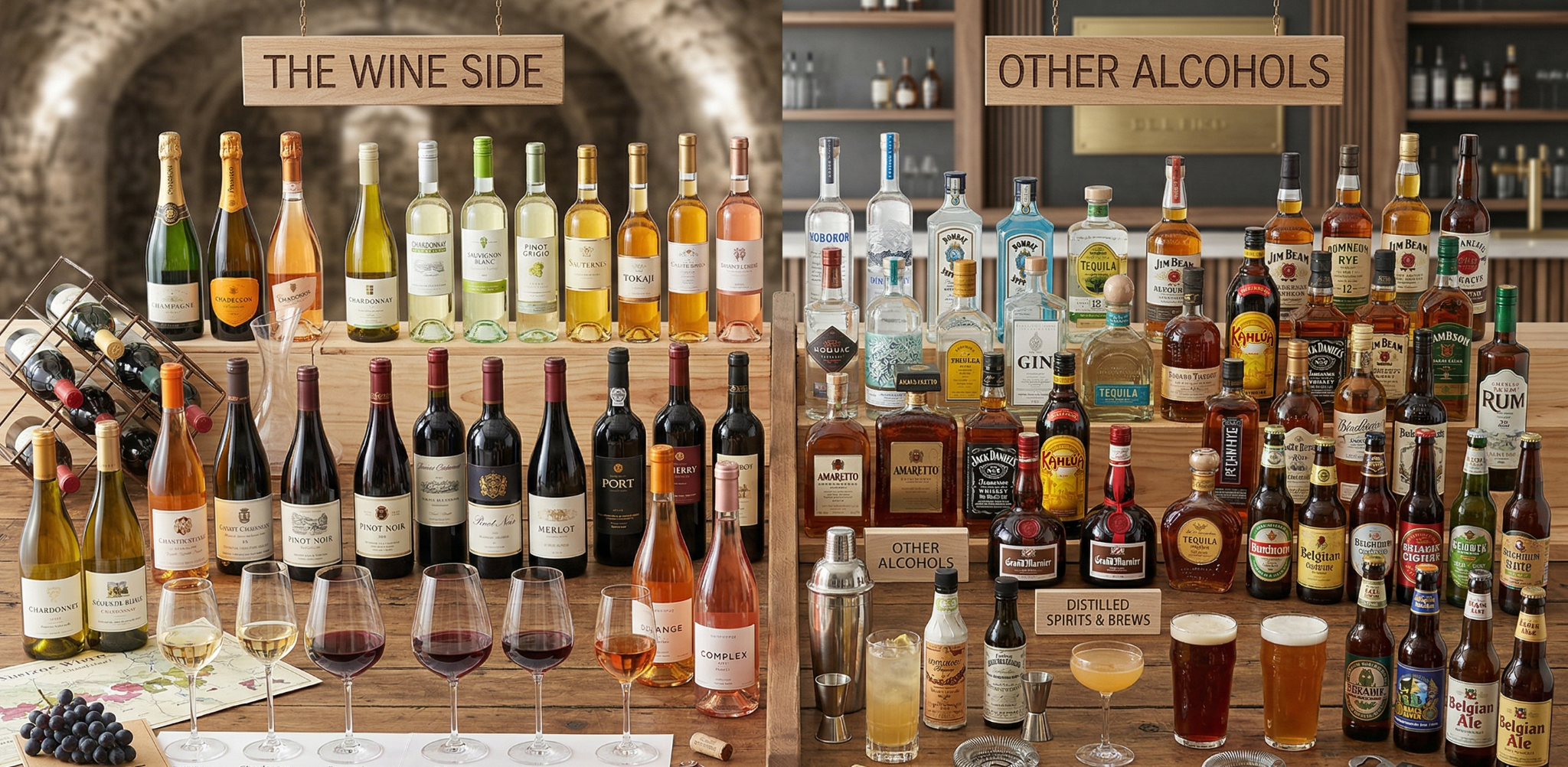
Here's where it gets interesting. Some studies suggest red wine might be slightly better for heart health than beer or spirits.
Why? Because of those extra polyphenols (like resveratrol, quercetin, and catechins) that come from grape skins. White wine has fewer because the skins are removed early. Beer and spirits have almost none.
One famous study (the Copenhagen City Heart Study) found that wine drinkers had a lower mortality rate than beer or spirits drinkers, even after adjusting for lifestyle factors.
But the difference isn't massive. A moderate drinker of beer or spirits still gets the HDL boost and clotting reduction from alcohol itself. The polyphenols in red wine are just a little bonus; like getting extra veggies with your dinner.
Bottom line: If you're going to drink, red wine is a great choice. But if you prefer a beer or a whiskey, you're probably still getting most of the heart benefits, as long as you keep it moderate.
This is where things go off the rails for a lot of people. "Moderate" doesn't mean "whatever feels chill to you." It's a specific, science-backed definition.
Moderate drinking means:
And a standard drink is:
So if you're pouring two large glasses of bold Cabernet every night, you're not "moderate." You're edging into heavy territory.
Why does it matter? Because the heart benefits peak at 1–2 drinks and then reverse. After that, risks for high blood pressure, atrial fibrillation, stroke, and liver disease start climbing fast.
More is not better. With alcohol, the sweet spot is small.
Let's be real: alcohol is a toxin. Your liver has to process it. And while small doses might have benefits, larger doses do real harm.
Heavy drinking (3+ drinks/day) increases risk of:
And it's not just the heart. Heavy drinking raises cancer risk (breast, colon, esophageal), damages the liver, disrupts sleep, and worsens mental health.
Here's the hard truth: If you're not already drinking, do not start for heart health. You can get the same benefits from exercise, a better diet, or statins: without the risks.
But if you already enjoy a glass or two with dinner? You're probably fine. Maybe even benefiting a little. Just don't tip over the edge.
Here's my take, as someone who loves wine but respects science:
Don't drink red wine for your heart. Drink it because you love it, because it relaxes you, because it tastes amazing with pasta, because it turns a Tuesday night into a small celebration.
If you drink moderately, you might get a little heart benefit as a bonus. But it shouldn't be the reason you pour.
The real heart hacks are boring but proven:
And guess what? Sharing a bottle of wine with friends checks that last box. So maybe the heart benefit isn't the resveratrol. Maybe it's the laughter, the slowing down, the feeling of being present.
That's the part I believe in.
If you're someone who enjoys wine regularly, the key is awareness. Not guilt. No restriction. Just knowing where you're at.
Are you having a glass most nights? Great. Are you creeping into two or three without noticing? Worth checking in.
This is where a tool like thewineoh.app comes in handy. It's not about tracking every calorie or policing yourself. It's about logging what you open, how much you pour, and how you feel after.
Over time, you'll see patterns:
It's gentle accountability. And it keeps wine in the "joy" column, not the "habit" column.

So, does red wine help your heart?
Yes, if:
No, if:
Red wine isn't medicine. It's not poison either. It's just… wine. Beautiful, complex, ancient wine. And if you treat it with respect, it might just love your heart back a little.
So pour your glass. Savor it. Share it. And don't overthink the resveratrol.
.svg)



Influencer
November 19, 2025
Consumers are shifting toward cleaner, additive-free wine experiences. Organic vineyards are proving that sustainable farming can elevate taste and quality. Here’s why clean wines are becoming the new favorite for mindful drinkers worldwide.
Discover More
.webp)
Influencer
November 21, 2025
Beyond cheese and charcuterie, the world of unexpected wine pairings is exploding. From sushi to spicy street food, new combinations are surprising wine lovers everywhere. Discover bold pairings that elevate both the dish and the glass.
Discover More
Influencer
November 19, 2025
Winemakers are blending centuries-old craftsmanship with cutting-edge tech innovations. Smart fermentation, AI-based grape analysis, and climate-controlled aging are reshaping the industry. A behind-the-scenes look at how technology is redefining experience.
Discover More.webp)
Influencer
November 19, 2025
Across the globe, female winemakers and sommeliers are redefining leadership in the wine world. Their creativity, precision, and bold ideas are inspiring a new era of wine culture. Meet the women changing how the world thinks, tastes, and talks about wine.
Discover More


