Is Wine Healthy or Unhealthy? A Critic's Unsparing Examination




February 1, 2026

Wine carries cultural weight far beyond the glass. It is ritual, romance, rebellion—a vessel for sophistication and escape. But when health claims enter the conversation, skepticism becomes mandatory. "Is wine healthy or unhealthy?" demands not sentiment but dissection.
This critic's examination rejects easy binaries. Wine is neither elixir nor poison; it is alcohol—a substance with pleasures and perils, benefits and burdens. The truth lies in the ledger: what does the evidence actually say, stripped of romance and vested interests?
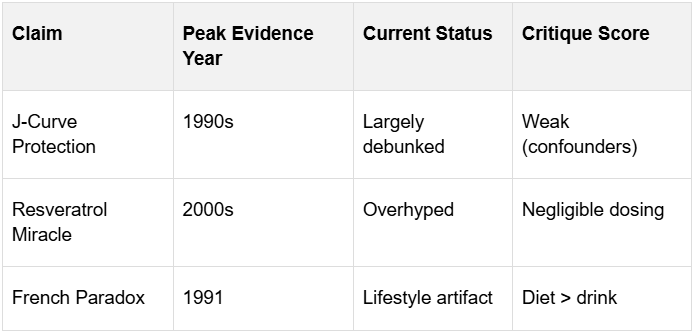
Wine's strongest health credential is cardiovascular. Observational studies since the 1990s suggested moderate drinkers (especially red wine consumers) had lower rates of heart disease than abstainers or heavy drinkers. The "J-curve" emerged: light intake appeared protective, heavy intake destructive.
Red wine's polyphenols—resveratrol chief among them—were hailed as the mechanism, antioxidants shielding arteries from oxidative damage. The French Paradox fueled the fire: how could butter-and-wine France outlive leaner America?
The critic's scalpel reveals cracks:
Resveratrol? Lab doses dwarf a glass's content; grapes, peanuts, berries deliver more without intoxication. The heart claim survives as a hypothesis, not prescription.
Alcohol is a Group 1 carcinogen. Full stop. Wine shares this classification with asbestos and tobacco—not equivalent in daily risk, but unequivocal in mechanism. Ethanol metabolizes into acetaldehyde, a DNA-damaging agent.
Even low-moderate intake elevates risk:
No safe threshold exists; risk accrues incrementally. A critic notes the asymmetry: potential heart gains (modest, contested) versus cancer losses (proven, persistent). Public health bodies increasingly state: the safest level is none.
Wine seduces as relaxant, but neuroscience tells a dual tale. Acute effects: GABA boost, anxiety melt. Chronic: tolerance demands more for the same calm; withdrawal breeds irritability.
The critic observes: wine's pleasure is real, but so is its quiet erosion of resilience.
Beyond cancer and brain:
These accumulate silently, confounding "moderate is fine" assurances.
Guidelines frame "moderate" as upper bounds:
Critic's caveats:
Nondrinkers gain nothing by starting; ex-drinkers risk relapse. Moderation serves harm reduction, not endorsement.
Wine "works" in studies within holistic patterns: Mediterranean diet, movement, community. Isolate alcohol, benefits evaporate. A cheeseburger with wine doesn't sanctify either; the vegetable plate does.
Antioxidants tantalize, but delivery matters. Supplements fail; wine's alcohol negates gains. Eat the grapes.
Resveratrol? Mouse miracles at 400mg/kg; human glass yields 1mg. Equivalent antioxidants abound alcohol-free: berries (50x), supplements (pure, dosed). Clinical trials? Null or negligible. Wine's delivery poisons the gift.
For these, "moderate" is mythology.
Wine sells transcendence. Health claims launder indulgence as virtue. Critics must call vested interests: vintners, sommeliers, lifestyle media profit from ambiguity. Science catches up slowly; culture lags.
"Is wine healthy or unhealthy?" yields no universal. Ask:
Experiment: 30 days off. Note sleep, mood, skin, clarity. Data trumps dogma.
Wine is unhealthy as net health input—risks (cancer, brain, liver) outweigh contested gains. It is healthy-adjacent in rare, controlled contexts: minuscule amounts, optimal lifestyles, no vulnerabilities.
Pleasure? Undeniable. Medicine? Unsubstantiated. Poison? Only in excess.
The critic urges: drink for joy, not justification. Or don't—and miss nothing essential.
Explore evidence-rated wines at TheWineOh.app—rate health context too. Truth awaits your palate and conscience.
.svg)



Influencer
November 19, 2025
Consumers are shifting toward cleaner, additive-free wine experiences. Organic vineyards are proving that sustainable farming can elevate taste and quality. Here’s why clean wines are becoming the new favorite for mindful drinkers worldwide.
Discover More
.webp)
Influencer
November 21, 2025
Beyond cheese and charcuterie, the world of unexpected wine pairings is exploding. From sushi to spicy street food, new combinations are surprising wine lovers everywhere. Discover bold pairings that elevate both the dish and the glass.
Discover More
Influencer
November 19, 2025
Winemakers are blending centuries-old craftsmanship with cutting-edge tech innovations. Smart fermentation, AI-based grape analysis, and climate-controlled aging are reshaping the industry. A behind-the-scenes look at how technology is redefining experience.
Discover More.webp)
Influencer
November 19, 2025
Across the globe, female winemakers and sommeliers are redefining leadership in the wine world. Their creativity, precision, and bold ideas are inspiring a new era of wine culture. Meet the women changing how the world thinks, tastes, and talks about wine.
Discover More


