How to Invest in Wine: The Data-Led Guide to Wine as a Financial Asset Class (2026)



March 30, 2026

You’re here because someone told you wine “outperforms stocks” and now you’re wondering if your basement could double as a hedge fund.
Good news: they’re not wrong. Bad news: it’s not that simple.
Here’s the scoreboard over the last 10 years:
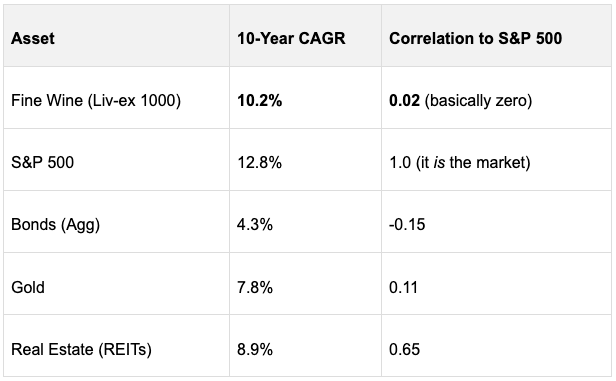
Translation: Wine gives you equity-like returns with bond-like independence. When stocks crash, wine usually shrugs and keeps going. That’s the diversification dream.
But, and this is a big, tannic but, only the right wines do this. Buy the wrong bottles, store them in your hot garage, and you’ve got an expensive vinegar collection, not a portfolio.
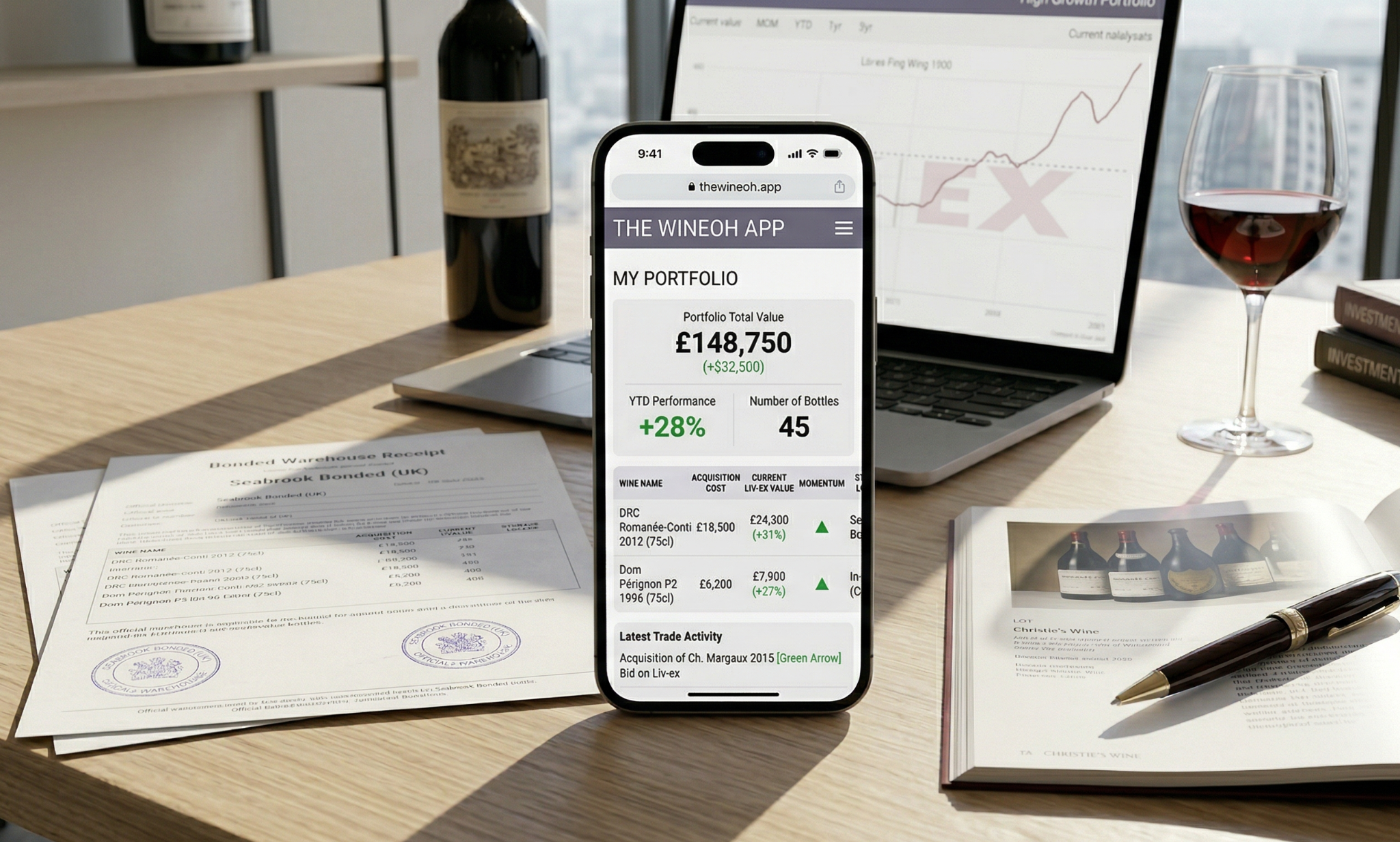
This guide shows you exactly which 5% of wines are investable, how to avoid the 95% that aren’t, and how to track it all in thewineoh.app so you’re not guessing when it’s time to sell.
Grab a glass (maybe not the investment-grade stuff yet). Let’s geek out.
Fine wine, tracked by the Liv-ex 1000 Index (the S&P 500 of wine), compounded at 10.2% CAGR over 20 years.
Head-to-head:
So, did it beat stocks? No, not quite. But here’s the kicker: it didn’t move with them.
Correlation measures how two assets move together. 1.0 = they dance in sync. 0 = they’re on different planets.
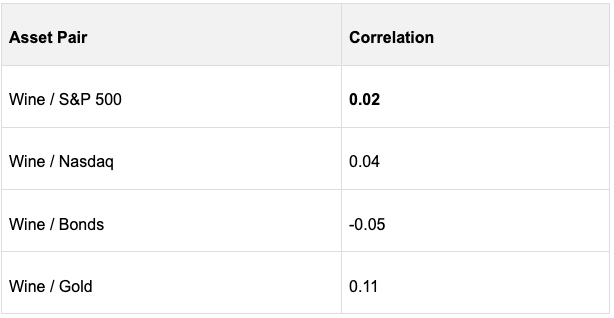
What this means: When tech stocks melted 34% in March 2020, fine wine was flat. In 2008, wine dropped 3% while stocks cratered 37%. That’s the magic: wine is your portfolio’s chill friend who doesn’t panic when everyone else does.
Portfolio hack: A 5–10% wine allocation reduces overall volatility without sacrificing returns. Log your wine % alongside stocks in thewineoh.app to see your real diversification.
Here’s the brutal truth: 95% of wine is meant to be drunk, not held. The investable 5% comes from specific regions, producers, and vintages.
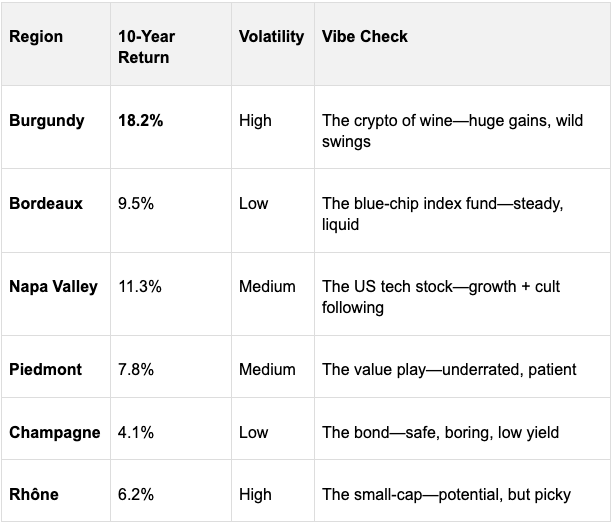
Takeaway: Burgundy prints money but will give you heart palpitations. Bordeaux is the reliable workhorse. Napa is the growth stock. Champagne? Cute, but don’t expect alpha.
These 10 names represent 54% of all fine wine trading volume. Liquidity is highest here; exit risk is lowest.
Strategy: Start here. These are the Apple, Microsoft, and Nvidia of wine. Use thewineoh.app to flag which bottles in your cellar are blue-chip vs. speculative bets.
Vintage variation drives 30-50% of price differences within the same producer. Buy a bad year, and you’re dead on arrival.
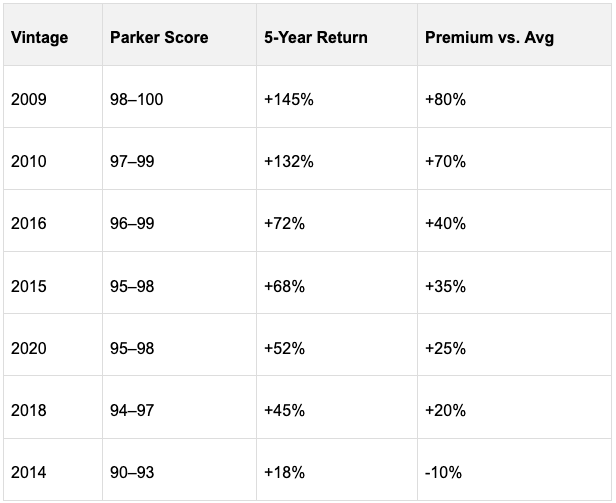
Pattern: 98+ point vintages from top châteaux outperform by 2–3x over 5 years. A 2009 Lafite isn’t just “better” than a 2014, it’s a different asset class.
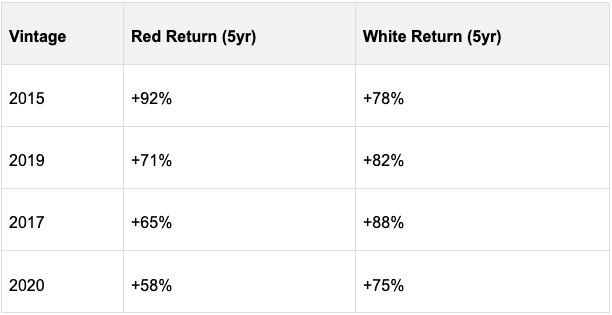
Insight: Burgundy vintages are tighter; even “good” years perform well due to scarcity. But 2015? That’s the golden ticket.
Tool tip: Log vintage + producer + score in thewineoh.app to flag which bottles have appreciation potential vs. “drink by 2028” windows.
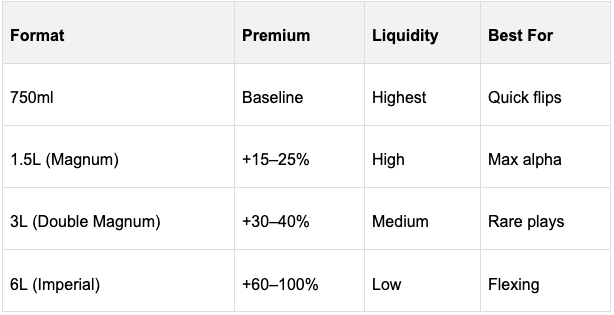
Data: Magnums of top Bordeaux appreciate 20% faster than 750ml over 10 years. Why? Scarcity + better aging ratio (less oxygen per ml).
Strategy: Buy magnums of blue-chip producers for max gains. Stick to 750ml if you might need to sell fast.
Auction data shows brutal gaps:
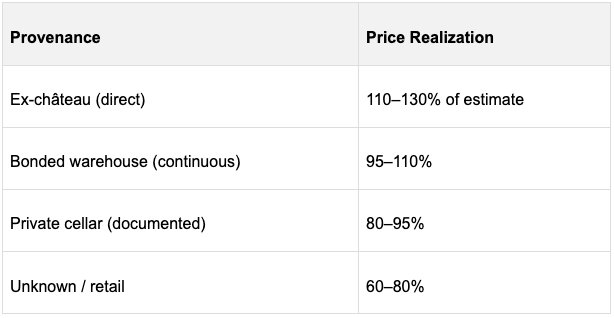
Risk: Poor storage (temperature swings, light) can destroy 30-50% of value instantly. A $5,000 bottle stored at 75°F for a year? Now it’s $2,500 vinegar.
Mitigation: Buy ex-château or from bonded warehouses. Store professionally (12-14°C, 70% humidity). Log storage location + temp logs in thewineoh.app for resale credibility.
Gross returns look sexy. Net returns pay your bills.
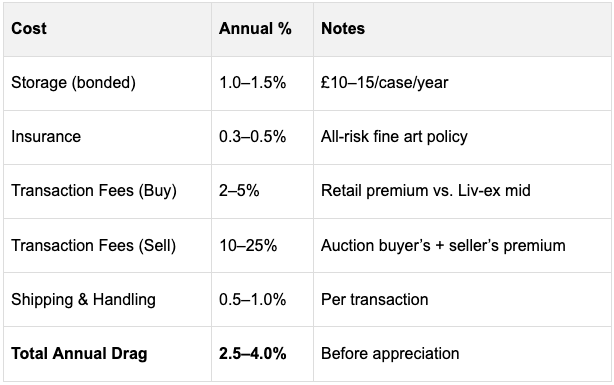
Net Reality: 10.2% gross CAGR becomes 6-8% net after costs. Still competitive, but not “get rich quick” territory.
Optimization: Hold 5-10 years minimum to amortize transaction fees. Use thewineoh.app to model net IRR including all costs; no surprises.
Wine is illiquid compared to stocks. The plan exists upfront.
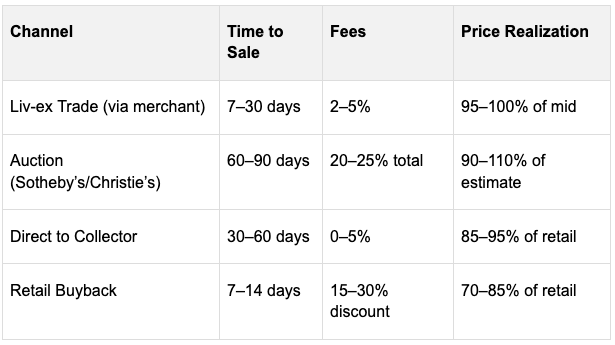
Best for speed: Liv-ex trade (if you have merchant access).
Best for price: Auction for rare/older bottles.
Worst for value: Retail buyback (last resort).
Strategy: Build relationships with 2-3 merchants pre-purchase. Log target exit price + preferred channel in thewineoh.app per bottle.
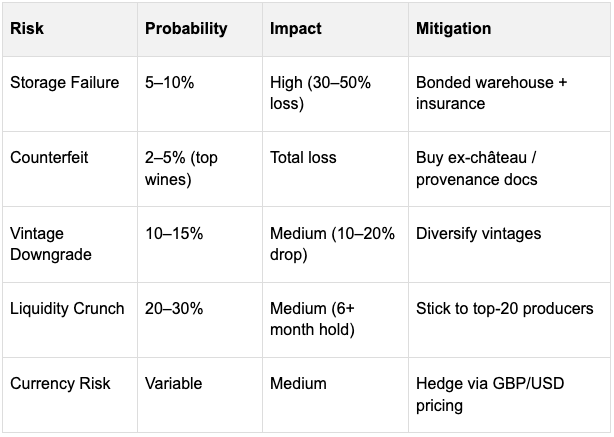
Counterfeit hotspots: 1945–1990 Bordeaux, DRC, Pétrus. Avoid ironclad provenance.
Hedge: Diversify across 5–10 producers, 3+ vintages, 2 regions. Use thewineoh.app to track concentration risk alerts—don’t let Lafite be 60% of your portfolio.
Expected Net CAGR: 6–8%
Volatility: Low
Liquidity: High
Expected Net CAGR: 8-12%
Volatility: Medium
Liquidity: Medium
Expected Net CAGR: 12-18% (higher risk)
Volatility: High
Liquidity: Low
Track all allocations in thewineoh.app with target weights, current weights, and rebalance alerts.
Pro move: Use bonded warehouses to defer VAT/duty until sale. Log tax lot info in thewineoh.app for year-end reporting.
Yes, if you treat it like an institution:
No, if you expect quick flips:
Final metric: 5-10% allocation, 7-10 year hold, blue-chip focus, professional storage, meticulous tracking.
Your next move: Start logging your investable bottles in thewineoh.app today: acquisition cost, current Liv-ex mid, storage location, target exit. Turn your cellar into a real portfolio, not a dusty hobby.
.svg)


Influencer
November 19, 2025
Consumers are shifting toward cleaner, additive-free wine experiences. Organic vineyards are proving that sustainable farming can elevate taste and quality. Here’s why clean wines are becoming the new favorite for mindful drinkers worldwide.
Discover More
.webp)
Influencer
November 21, 2025
Beyond cheese and charcuterie, the world of unexpected wine pairings is exploding. From sushi to spicy street food, new combinations are surprising wine lovers everywhere. Discover bold pairings that elevate both the dish and the glass.
Discover More
Influencer
November 19, 2025
Winemakers are blending centuries-old craftsmanship with cutting-edge tech innovations. Smart fermentation, AI-based grape analysis, and climate-controlled aging are reshaping the industry. A behind-the-scenes look at how technology is redefining experience.
Discover More.webp)
Influencer
November 19, 2025
Across the globe, female winemakers and sommeliers are redefining leadership in the wine world. Their creativity, precision, and bold ideas are inspiring a new era of wine culture. Meet the women changing how the world thinks, tastes, and talks about wine.
Discover More


