How Much Wine Is in a Standard Bottle?


How Much Wine Is in a Standard Bottle?

March 3, 2026

In this Blog

Alright, wine lovers and curious sippers, picture this: you’re hosting friends, pop a bottle, pour “generous” glasses, and suddenly it’s gone after what feels like two minutes. “Wait, wasn’t that supposed to last longer?” Sound familiar? You’re not alone. Today, we’re cracking open the mystery of how much wine actually lives in that green glass tower and why knowing matters for your wallet, your waistline, and your wine nights.
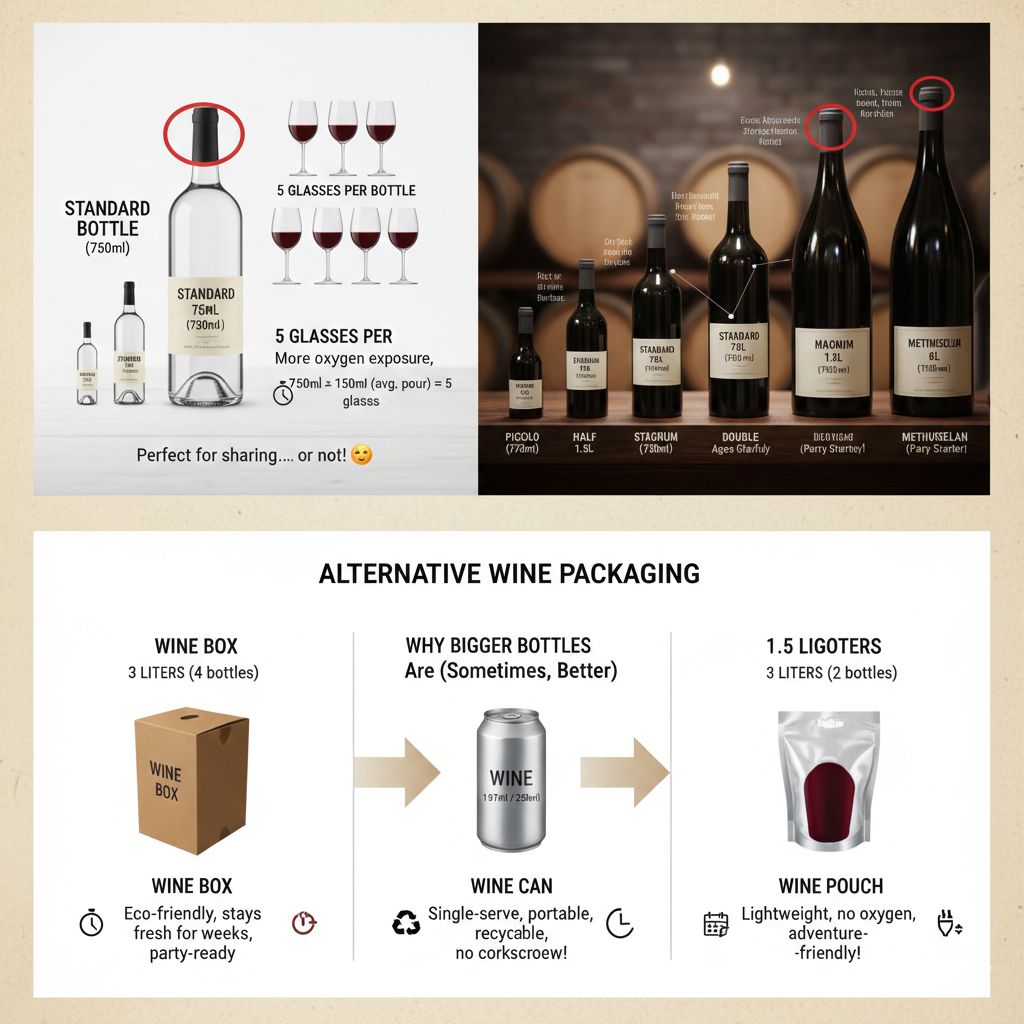
an infographic different sizes and packing of wines

The "Standard" Standard: What Even Is It?

When we talk about a "standard" wine bottle, we're generally referring to the 750 milliliter (mL) size. This is the most common bottle you'll find on shelves worldwide, from your local grocery store to the most exclusive wine shops.


Why 750 mL? The History (and a bit of a chuckle)

Why 750 mL and not a nice round liter, or a more American-friendly quart? The history is a delightful blend of tradition, trade, and perhaps a touch of legislative stubbornness.

  1. British Imperial System Influence: Back in the day, when wine trade was booming between France and Britain, the British used imperial gallons. One imperial gallon is approximately 4.5 liters. A common shipping container, the "hogshead," held 63 gallons. When these large containers were broken down into individual bottles for sale, 750 mL became the convenient, standard measure that divided evenly. Six 750 mL bottles make exactly 4.5 liters, or one imperial gallon. It was a neat way to account for trade.
  2. Glass Blowing Limitations: In the earlier days of glass manufacturing, blowing perfectly uniform, large bottles was challenging. 750 mL was a practical and manageable size for glassblowers.
  3. Modern Standardization: In the 1970s, the European Union officially standardized the 750 mL bottle size, which the United States then adopted in 1975 to facilitate international trade. So, what started as a practical measure became a global norm.

So, while it might seem arbitrary, there's a good reason that most of the wine in the world comes in this specific package.


Decoding the 750 mL: Pours, Glasses, and Servings

Now that we know the magic number is 750 mL, let's break down what that means for your actual wine-drinking experience.

How many glasses are in a 750 mL bottle?

This is where things get a little squishy, because "a glass" of wine isn't universally defined. However, generally:

  • Standard Pour: Most restaurants and wine professionals consider a standard pour of wine to be 5 ounces (oz).
  • Metric Conversion: 5 ounces is approximately 147 mL.
  • Calculation: If you divide 750 mL by 147 mL per pour, you get about 5.1 glasses per bottle.

So, a good rule of thumb is 5 glasses per standard 750 mL bottle.


Planning for a Party? Here's the Math!

Let's say you're hosting a small get-together.

  • For 4 people: If everyone has one glass, you'll have one glass left over. If everyone has two glasses, you'll need two bottles.
  • For 6 people: If everyone enjoys just one glass, you'll need a minimum of two bottles (6 glasses total). If they're feeling jovial and want a second, you'll need three bottles.
Five friends gathered dinner at home and one serving wine while others are sitting around table

Remember, these are guidelines! Some people pour more generously (we've all been there!), and some wines are meant to be savored in smaller quantities. For more detailed guides on hosting, wine pairings, and managing your wine consumption, check out The Wine Oh App.


Beyond the Standard: A World of Wine Bottle Sizes

While 750 mL reigns supreme, the world of wine bottles is actually a grand family of varying sizes, often named after biblical figures (because, why not add a layer of ancient mystique to your giant bottle of Chardonnay?). These larger formats aren't just for show; they can actually be better for aging wine!

Let's meet the extended family:

  1. Piccolo (or Split): 187.5 mL (1/4 of a standard bottle).
    • Pours: ~1 glass.
    • Use: Perfect for single servings, individual sparkling wines, or when you just want a taste without opening a whole bottle. Great for picnics!
  2. Half (or Demi): 375 mL (1/2 of a standard bottle).
    • Pours: ~2.5 glasses.
    • Use: Ideal for a quiet evening for one, or for when you want to sample two different wines without committing to full bottles.
  3. Standard: 750 mL.
    • Pours: ~5 glasses.
    • Use: The everyday champion.
  4. Magnum: 1.5 Liters (2 standard bottles).
    • Pours: ~10-11 glasses.
    • Use: Parties, celebrations, and larger gatherings. Wine in magnums often ages better due to the larger volume of wine having less exposure to oxygen.
  5. Double Magnum: 3 Liters (4 standard bottles).
    • Pours: ~20-22 glasses.
    • Use: Grand celebrations! (Also called Jeroboam for still wines, and a different size for Champagne).
  6. Jeroboam (Champagne): 3 Liters.
    • Pours: ~20-22 glasses.
    • Use: Champagne celebrations. (Confusingly, a Jeroboam for still wine is 4.5 Liters in Bordeaux and 3 Liters in Burgundy. We said it was fun, not simple!)
  7. Rehoboam: 4.5 Liters (6 standard bottles).
    • Pours: ~30-33 glasses.
    • Use: Reserved for Champagne.
  8. Methuselah: 6 Liters (8 standard bottles).
    • Pours: ~40-44 glasses.
    • Use: Very large parties or collectible display pieces.
  9. Salmanazar: 9 Liters (12 standard bottles).
    • Pours: ~60-66 glasses.
    • Use: The equivalent of a full case of wine in one giant bottle! Talk about a statement.
  10. Balthazar: 12 Liters (16 standard bottles).
    • Pours: ~80-88 glasses.
    • Use: Are you hosting a small festival?
  11. Nebuchadnezzar: 15 Liters (20 standard bottles).
    • Pours: ~100-110 glasses.
    • Use: Legend says this is what they serve at royal weddings.
  12. Melchior: 18 Liters (24 standard bottles).
    • Pours: ~120-132 glasses.
    • Use: The ultimate showstopper, equal to two full cases of wine!
  13. Solomon: 20 Liters (26 standard bottles).
  14. Sovereign: 25 Liters (33 standard bottles).
  15. Goliath (or Primat): 27 Liters (36 standard bottles).
  16. Melchizedek (or Midas): 30 Liters (40 standard bottles).

You probably won't be casually picking up a Nebuchadnezzar at your local wine store, but it's fascinating to know these colossal bottles exist! For those who love collecting and cellaring, these larger formats are highly prized.


Why Bigger Bottles Are (Sometimes) Better

It's not just about bragging rights (though that's definitely part of it with a Methuselah!). Larger format bottles offer distinct advantages for wine aging:

  • Less Oxygen Exposure: The ratio of wine to the air pocket (ullage) at the top of the bottle is smaller in larger bottles. This means the wine is exposed to less oxygen over time, which slows down the aging process.
  • Slower, More Graceful Aging: With less oxygen, the wine ages more slowly and often more gracefully, allowing complex flavors to develop without prematurely oxidizing. This is why many collectors seek out magnums and even larger bottles for their prized vintages.
  • Consistent Temperature: Larger volumes of liquid are less susceptible to rapid temperature fluctuations, providing a more stable environment for the wine during long-term storage.

So, if you're cellaring a special bottle of Cabernet Sauvignon or a vintage Champagne for a momentous occasion, a magnum might be an investment worth considering!


Final Pour: The Wisdom of Wine Volume

So, the next time you hold a standard 750 mL bottle, you'll know it's not just a random size, but a global standard steeped in history and trade. You'll also be able to confidently estimate your pours, plan your parties, and maybe even dream of uncorking a majestic Methuselah one day.

Asian sommelier woman looking at a glass of red wine in her hand very attentively

Understanding wine isn't just about tasting notes; it's about appreciating the journey of the grape from vine to glass, and even the vessel it travels in.

For more deep dives into wine knowledge, from understanding different grape varietals like a perfect Pinot Noir to mastering the art of wine and food pairings, head over to The Wine Oh App. We're here to make your wine journey as enlightening as it is enjoyable.

Now, go forth and pour with confidence! Cheers!

Related Blogs

Influencer

November 19, 2025

The Rise of Organic & Clean Wines

Consumers are shifting toward cleaner, additive-free wine experiences.
Organic vineyards are proving that sustainable farming can elevate taste and quality.
Here’s why clean wines are becoming the new favorite for mindful drinkers worldwide.

Discover More
Discover More

Influencer

November 21, 2025

Wine & Food Pairings You’ve Never Tried Before

Beyond cheese and charcuterie, the world of unexpected wine pairings is exploding.
From sushi to spicy street food, new combinations are surprising wine lovers everywhere. Discover bold pairings that elevate both the dish and the glass.

Discover More
Discover More

Influencer

November 19, 2025

Inside the Modern Winery: Technology Meets Tradition

Winemakers are blending centuries-old craftsmanship with cutting-edge tech innovations. Smart fermentation, AI-based grape analysis, and climate-controlled aging are reshaping the industry. A behind-the-scenes look at how technology is redefining experience.

Discover More
Discover More

Influencer

November 19, 2025

Women Who Are Shaping the Future of Wine

Across the globe, female winemakers and sommeliers are redefining leadership in the wine world. Their creativity, precision, and bold ideas are inspiring a new era of wine culture. Meet the women changing how the world thinks, tastes, and talks about wine.

Discover More
Discover More