How Much Should You Spend on Wine? (Price vs. Quality, No Snobbery Allowed)



April 9, 2026

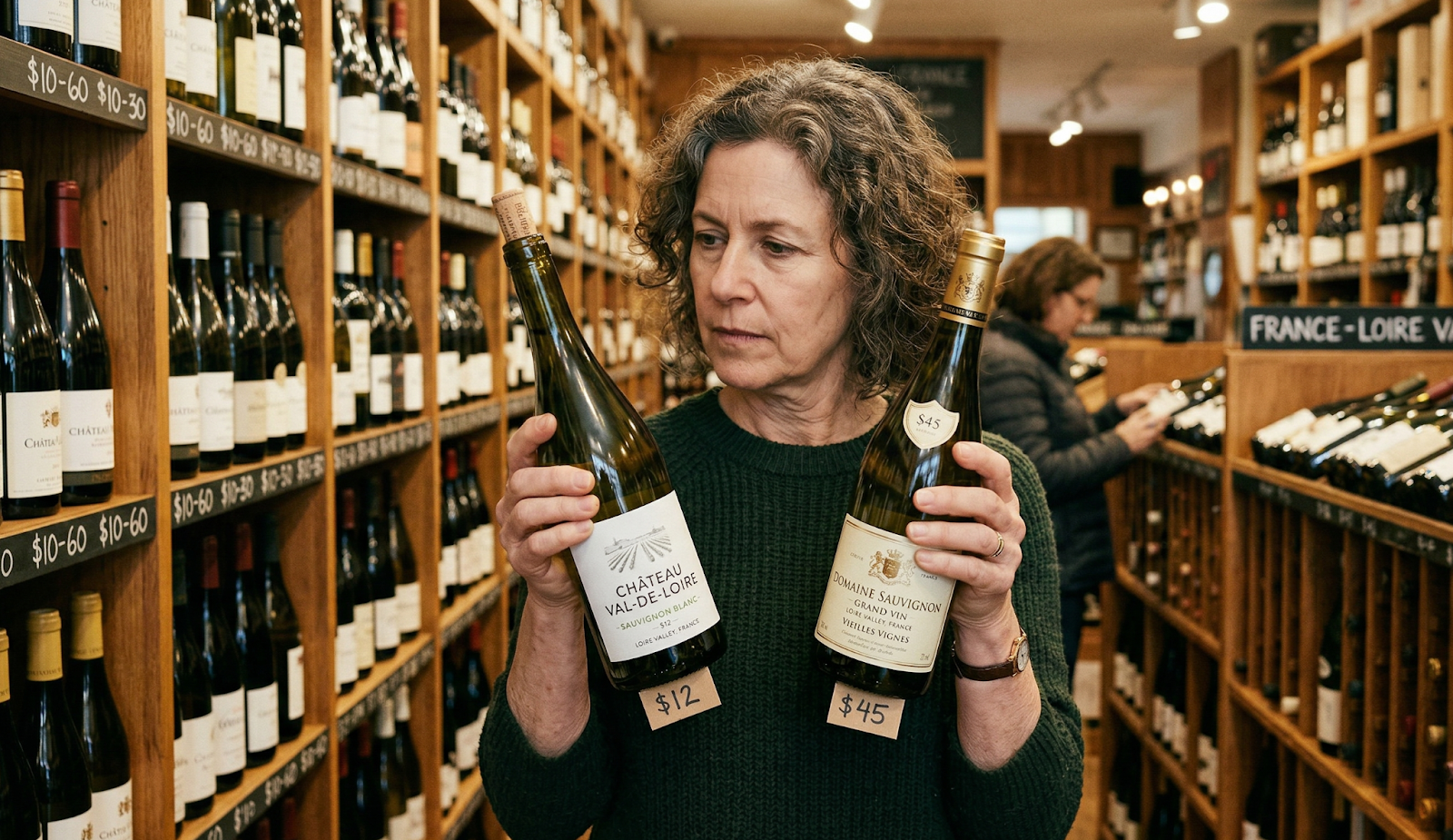
Let's address the elephant in the wine shop: You're standing in the aisle, holding two bottles. One is $12. The other is $45. They look similar. They're from the same region. Same grape, even.
Your brain starts screaming: Is the expensive one actually better? Or am I just funding someone's marketing budget?
It's the oldest question in the wine world. And the answer is… complicated. But also kind of liberating.
Here's the truth: Price does correlate with quality, but only up to a point. After that, you're paying for scarcity, reputation, aging potential, and the story on the back label. You're not necessarily paying for a better taste in your glass tonight.
So, how much should you spend? It depends on what you want from the bottle. Are you drinking it with Tuesday tacos? Celebrating a promotion? Trying to impress a date? Investing for 2035?
Let's break down the price tiers, debunk the myths, and find your personal sweet spot. And because the only way to know what's worth it for you is to track it, I'll show you how to log your buys in thewineoh.app at the end. That way, you're not just spending; you're learning.
Ready? Let's talk money.
Before we judge price tags, let's understand them. Wine pricing isn't random. It's built on a few hard costs and a few soft ones.
The Hard Costs (What You're Actually Paying For):
The Soft Costs (The "Fluff" Factor):
The takeaway: A $15 wine covers hard costs + small margin. A $150 wine covers hard costs + prestige + scarcity + aging + ego.
Let's get specific. Here's what your money buys you in 2026.
What you get: Drinkable, simple, fruit-forward wines. Often mass-produced from high-yield vineyards. Minimal oak (maybe chips or staves instead of barrels).
Best for: Weeknight sipping, cooking, big parties where quantity > quality.
The Trap: Some are thin, acidic, or have that "chemical" finish. But gems exist (Trader Joe's Two Buck Chuck is… fine).
Verdict: Good enough. Don't expect complexity, but don't fear it either.
What you get: The biggest jump in quality per dollar. Better grapes, real fermentation (not concentrate), maybe some neutral oak. Regional characters start to show.
Best for: Daily drinking, casual dinners, trying new varieties without risk.
The Magic: This is where blind taste tests often beat the $40+ bottles. Why? Because the winemaking is solid, but you're not paying for prestige.
Verdict: The Smart Buy. If you're on a budget, live here.
What you get: Distinct terroir, better vineyard sites, new oak (if appropriate), lower yields. These wines taste like somewhere. A Willamette Pinot actually tastes like Willamette, not just "red fruit."
Best for: Date nights, dinner parties, gifts, "I want to taste something special" moments.
The Reality: This is the ceiling for most people's daily drinkers. The quality is high, but the law of diminishing returns is starting to kick in.
Verdict: The Treat. Worth it for occasions, but maybe not every Tuesday.
What you get: Prestige cuvées, iconic regions (Napa Cab, Burgundy Grand Cru), low production, aging potential. You're paying for reputation and scarcity as much as liquid.
Best for: Milestones, collecting, vertical tastings, showing off (no shame).
The Trap: Blind tests show even experts struggle to distinguish these from Tier 3 wines half the time. The "placebo effect" of price is real.
Verdict: The Splurge. Enjoy it, but know you're paying for the story too.
What you get: History, rarity, investment potential. These are liquid assets.
Best for: Collectors, investors, once-in-a-lifetime experiences.
Verdict: The Fantasy. Unless you're deep in the game, skip this for retail therapy.
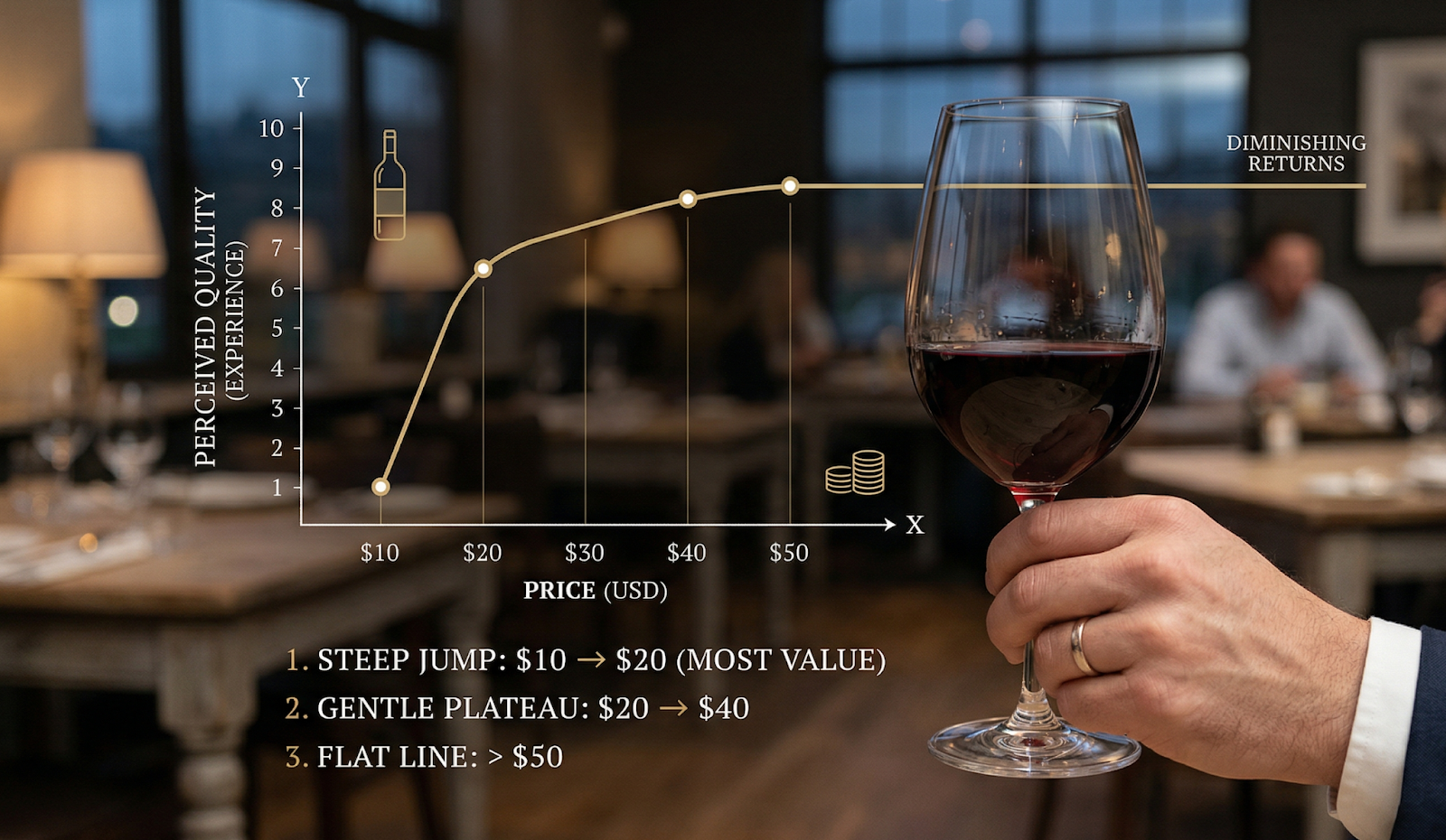
Here's the graph you need in your head:
Translation: A $20 wine is significantly better than a $10 one. A $40 wine is a bit better than a $20 one. A $100 wine is often indistinguishable from a $50 one unless you're a trained pro in a controlled setting.
The Blind Test Truth: In the famous "Princeton Wine Study," experts couldn't tell the difference between cheap and expensive wines in blind tastings. In fact, they sometimes rated the cheaper wine higher when they didn't know the price.
Your brain plays tricks on you. When you know a wine costs $100, your pleasure centers light up more. When it's $15, they don't. It's not the wine; it's the expectation.
Want to spend $20 but taste like $40? Buy from these regions:
Avoid if you're budget-conscious: Napa Cabernet (tax on the name), Burgundy (scarcity tax), Champagne (unless it's Cava or Crémant).
Not all bottles are created equal. Match your spend to the moment.
Save ($15-$25) When:
Splurge ($40-$75) When:
The Rule of Thumb: Spend more on the wine if the food is simple. Spend less on the wine if the food is complex.
Here's the thing: My $25 sweet spot might be your $15 one. Or your $50 one. Taste is subjective. The budget is personal.
The only way to know is to track.
If you buy a $12 bottle and rate it 5 stars, and then buy a $45 bottle and rate it 4 stars… guess what? The $12 bottle is better value for you.
But if you consistently rate $40 bottles higher and feel the complexity is worth it? Then that's your zone.
The Problem: We forget. We drink a great $18 Malbec, love it, and six months later, we can't remember the brand. So we buy a $30 one that's… meh.
The Fix: Log it.Open thewineoh.app. Scan the bottle. Enter the price. Rate it 1-5 stars. Add a quick note: "Best $15 I ever spent" or "Overhyped, too oaky."
Do this for a month. Then look at your data.
That's your personal price-to-pleasure ratio. And no sommelier can tell you that. Only you can.
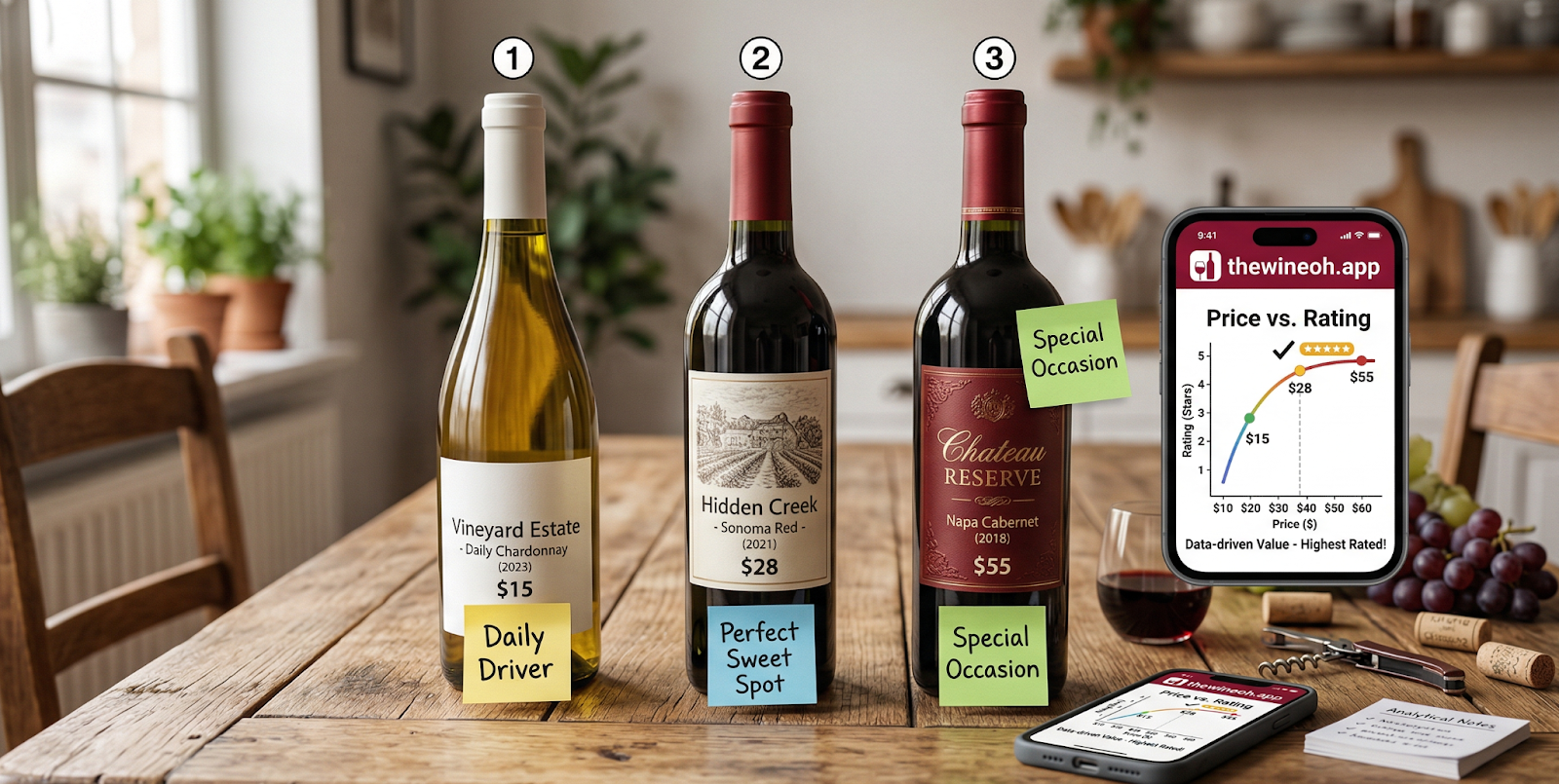
Here's my permission slip for you: It is okay to drink $15 wine.
It is also okay to love $60 wine.
The "best" wine isn't the most expensive one. It's the one that makes you smile, fits your budget, and tastes good with your dinner.
Don't let price tags intimidate you. Don't let snobbery dictate your glass. Buy what you like. Drink what you love. And if you want to get smarter about where your money goes, track it in thewineoh.app. Because in the end, the only rating that matters is the one you give it.
Cheers to smart spending.
.svg)


Influencer
November 19, 2025
Consumers are shifting toward cleaner, additive-free wine experiences. Organic vineyards are proving that sustainable farming can elevate taste and quality. Here’s why clean wines are becoming the new favorite for mindful drinkers worldwide.
Discover More
.webp)
Influencer
November 21, 2025
Beyond cheese and charcuterie, the world of unexpected wine pairings is exploding. From sushi to spicy street food, new combinations are surprising wine lovers everywhere. Discover bold pairings that elevate both the dish and the glass.
Discover More
Influencer
November 19, 2025
Winemakers are blending centuries-old craftsmanship with cutting-edge tech innovations. Smart fermentation, AI-based grape analysis, and climate-controlled aging are reshaping the industry. A behind-the-scenes look at how technology is redefining experience.
Discover More.webp)
Influencer
November 19, 2025
Across the globe, female winemakers and sommeliers are redefining leadership in the wine world. Their creativity, precision, and bold ideas are inspiring a new era of wine culture. Meet the women changing how the world thinks, tastes, and talks about wine.
Discover More


