Can I Drink Wine on Keto or Whole30? A Data-Led Reality Check




March 8, 2026

Short answer: it depends on the diet, the details of the wine, and how honest you are with your tracking. Let’s break it down like a calm, data‑led friend, not a “never drink again” lecture. I’ll walk you through Keto, “low‑carb” in general, and Whole30, then give you a practical playbook you can actually use.
If you want help picking specific bottles that fit your targets, you can always use a helper like thewineoh.app alongside this.
Before we talk about Keto or Whole30, we need numbers.
A standard glass = 5 oz / 150 ml.
Typical dry table wines per glass:
Key pattern:
So if your daily carb limit is tight (like Keto 20–30 g net carbs/day), 1–2 glasses of dry wine can technically fit—but that’s only half the story.
Keto isn’t just “low carb”; it’s about keeping carb intake so low (often 20–50 g/day) that your body shifts to burning fat and producing ketones.
Wine affects Keto in two ways:
That second point is why some experts say “you can drink on Keto, but it may slow progress.”
Low‑carb / Keto resources typically say:
Diet Doctor’s Keto alcohol guide lists:
So wine is generally more Keto‑friendly than beer, especially if you choose dry styles.
Most sources land on:
Also, alcohol lowers inhibitions. Even if the wine itself “fits,” the snacks that follow (bread, fries, dessert) often don’t.
If you want to be strict Keto (therapeutic or medical reasons), many doctors and Keto educators suggest avoiding alcohol altogether or using it very sparingly.
If your Keto is more lifestyle/weight loss oriented, well‑chosen dry wines in moderation can usually be worked in.
Based on carb content and dryness:
If you’re not sure what category a bottle falls into, you can either check the producer’s tech sheet, or use something like thewineoh.app to sanity‑check sweetness/carb expectations before pouring.
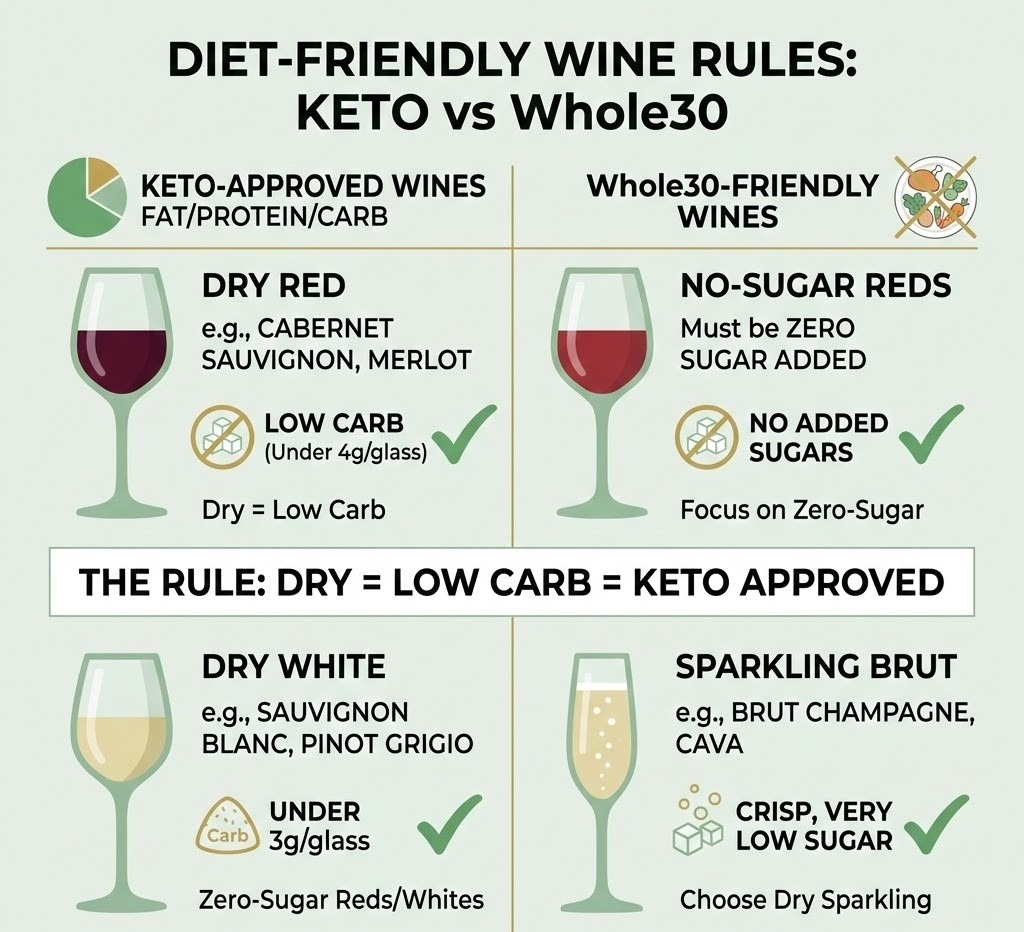
Whole30 has a very clear rule:
No alcohol at all for 30 days.
This includes:
The intention of Whole30 is a strict “reset” for 30 days—physically and psychologically. Alcohol is off the list not just for calories or carbs, but because it affects sleep, cravings, habits, and judgment.
They’ve made tiny exceptions for vinegar and botanical extracts (like vanilla extract) that contain alcohol but aren’t drinkable.
But actual wine in a glass, even “just one with dinner,” is explicitly not allowed on Whole30.
So:
If you’re doing something like a “Whole30‑ish” or post‑Whole30 maintenance, wine can be reintroduced carefully, but that’s technically no longer the official program.
If you’re on a general low‑carb plan (say 50–100 g/day), dry wine is usually easy to fit in:
So in a sensible low‑carb diet, 1–2 glasses of dry wine a few times a week is generally compatible; assuming you’re also in a calorie deficit and not using wine to justify late‑night snacking.
One glass of dry wine is roughly 120–125 calories.
If you’re aiming for a 500‑calorie daily deficit, then:
So wine can absolutely fit into a calorie‑controlled plan, but you need to account for it just like food, and be honest with portion sizes (home pours are often 6–7 oz, not 5).
Interestingly, at least one small trial comparing white wine vs grape juice in a calorie‑restricted diet found similar weight loss in both groups over 3 months; about 4 kg on average. That suggests moderate wine can coexist with weight loss in a structured plan, but this doesn’t negate all the known long‑term risks of alcohol.
If you decide wine is worth keeping in your plan, here’s a data‑led way to do it:
For most people aiming for health + weight management, a reasonable framework is:
More than that, regularly, and the math (and biology) start working against you.
Prioritize:
Avoid:
If you’re unsure, comparing label info or scanning with a helper like thewineoh.app can keep you from accidentally picking a sugar‑bomb.
Count:
Plug it into whatever tracker you’re using. Don’t let wine float as “mystery calories.”
Instead of memorizing carb ranges for every grape, you can use something like thewineoh.app as a practical sidekick:
Think of it as the part of your brain that remembers both taste and macros, so you can stay in your lane without turning every glass into a math problem.
So yes, you might be able to drink wine on your specific diet—but the more precise question is:
“How often, how much, and is it worth the trade‑off for my goals?”

If the answer still feels fuzzy, start with 1–2 glasses of dry wine per week, track everything honestly for a month, and see what your body, your progress, and your sleep say back.
.svg)



Influencer
November 19, 2025
Consumers are shifting toward cleaner, additive-free wine experiences. Organic vineyards are proving that sustainable farming can elevate taste and quality. Here’s why clean wines are becoming the new favorite for mindful drinkers worldwide.
Discover More
.webp)
Influencer
November 21, 2025
Beyond cheese and charcuterie, the world of unexpected wine pairings is exploding. From sushi to spicy street food, new combinations are surprising wine lovers everywhere. Discover bold pairings that elevate both the dish and the glass.
Discover More
Influencer
November 19, 2025
Winemakers are blending centuries-old craftsmanship with cutting-edge tech innovations. Smart fermentation, AI-based grape analysis, and climate-controlled aging are reshaping the industry. A behind-the-scenes look at how technology is redefining experience.
Discover More.webp)
Influencer
November 19, 2025
Across the globe, female winemakers and sommeliers are redefining leadership in the wine world. Their creativity, precision, and bold ideas are inspiring a new era of wine culture. Meet the women changing how the world thinks, tastes, and talks about wine.
Discover More


